
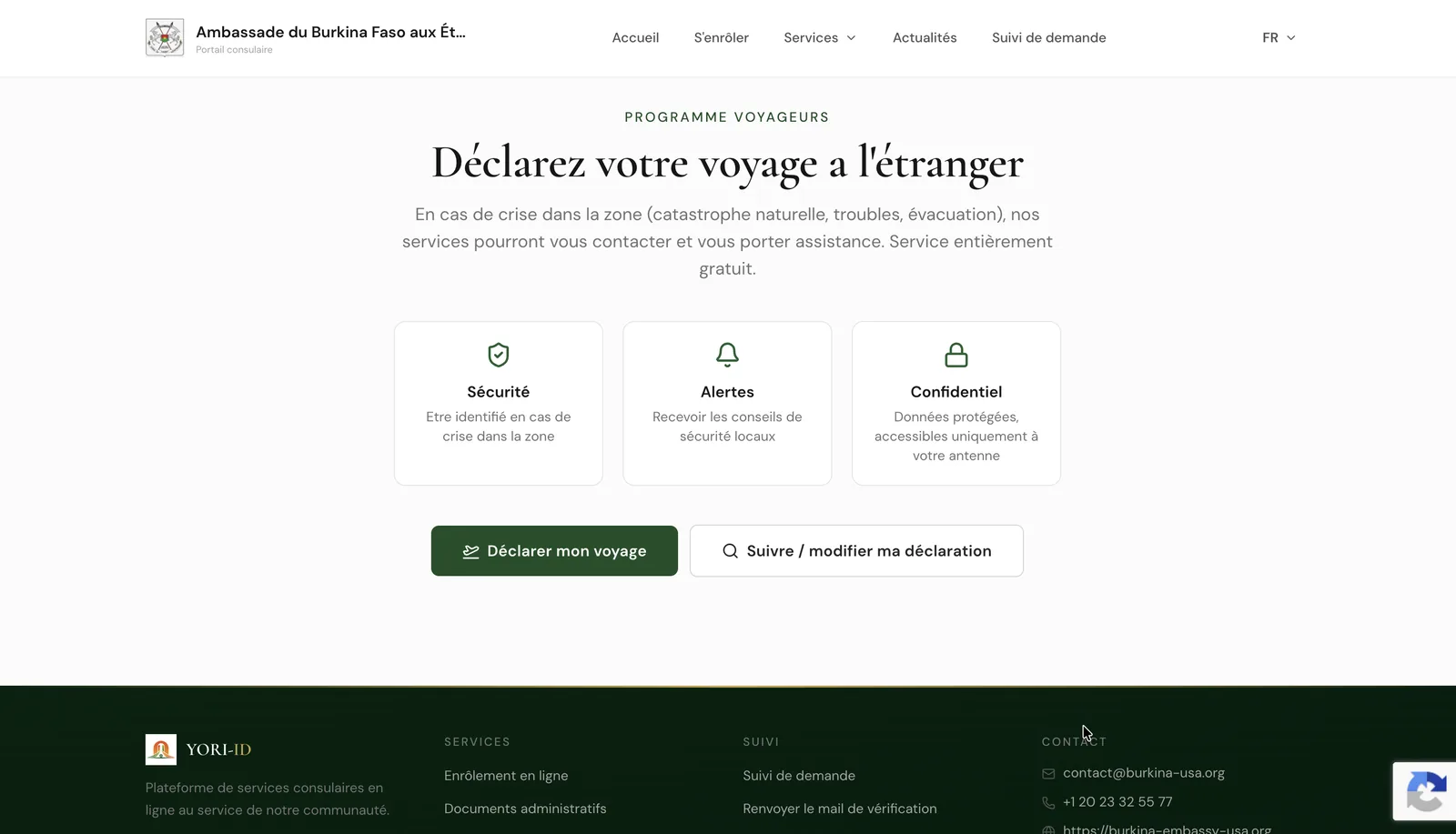
Travel declaration and tracking of visiting nationals
A mission knows its registered residents. It almost never knows which of its nationals happen to be on its territory for three weeks. In a natural disaster, civil unrest or an evacuation, that is exactly the population it cannot reach.
The blind spot in a consular register
Consular registration answers one question — who lives here on a lasting basis — and only that one. The business traveller, the exchange student, the national who came for a funeral do not appear in it, and have no reason to sign up.
When a crisis hits, the mission is then working from a register describing a settled population, while part of the population needing help is mobile and invisible.
A four-step declaration, free of charge
The declaration must stay frictionless: it grants the declarant no credential and no right, its only return is being reachable. Any superfluous requirement drives the declaration rate down.
- Contact details and the consular representation to attach to
- Travel: destination country and city, purpose, arrival and expected departure dates
- On site: accommodation address, local phone number, emergency contact — all optional
- Summary, explicit consent, submission
Four states, so the list stays accurate
A traveller register is only worth having if it empties. A declaration left "registered" indefinitely after the traveller has gone home produces a list that overstates the population present — and a list nobody uses in a crisis.
The four states separate an announced trip, a stay in progress, a completed stay and a cancelled declaration.
| State | Meaning |
|---|---|
| Registered | Trip declared, arrival still to come |
| In country | The traveller is within the mission's area of responsibility |
| Completed | Stay finished, the declarant leaves the active lists |
| Cancelled | Trip cancelled by the declarant, permanently |
Amendment and cancellation by the declarant
Trips shift, get extended, change shape. The declarant amends their declaration with their tracking code and a verification code sent by email — with no account to create.
Identity, destination and tracking code stay fixed: they are what gives the declaration its evidential value. Everything else — dates, accommodation, local phone, emergency contact — changes freely.
What the mission does with it
The scheme answers two questions: how many of our nationals are in the country right now, and how do we reach all of them in one send.
On the officer side, declarations are searchable by status, branch, destination country, purpose and arrival date range. An officer can also create or amend a declaration at the counter, for the traveller who turns up without having declared online.
Group messaging targets those same criteria. The number of recipients is shown before sending — you know who you are addressing before you address them — and every campaign is kept: criteria used, sending officer, successful sends and failures.
- Nationals currently in the country, and arrivals still to come
- Breakdowns by purpose of travel and destination country, leading destinations per branch
- Twelve-month trend
- Automatic state changes as arrival and end-of-stay dates pass, with notification
Frequently asked questions
Is the declaration mandatory?
No, and it is free. It grants no right: its only function is to make the traveller reachable should a crisis occur in the area during their stay.
Do I have to be registered with the mission?
No. That is precisely the point of the scheme: it targets visiting nationals, who have no reason to register as residents.
Who can see the declared information?
Only the consular representation the declarant selected. The sensitive fields — accommodation, local phone, emergency contact — are optional and do not condition the declaration.
How do I amend or cancel a declaration?
With the tracking code received by email and a verification code sent to the same address. Identity and destination cannot be changed; dates and on-site contact details can.
Can the mission contact travellers in bulk?
Yes, through group messaging targeted on status, branch, purpose or destination country. The recipient count is shown before sending, and every campaign is archived with its criteria and its outcome.