
Passport applications, from filing to handover
The passport is the longest and most opaque consular procedure for the applicant: they file a case, then hear nothing until a phone call. YORI-ID covers the entire chain and names each of its fifteen states — including the shuttle between the embassy and the passport service, which elsewhere runs on diplomatic bag or email.
Three types of application
A passport service does not handle a single case. All three types share the same processing path but require neither the same documents nor the same checks.
| Type | Situation | Specifics |
|---|---|---|
| First application | The applicant has never held a passport | Full civil status verification |
| Renewal | Expiry, loss, theft, damage, pages exhausted, change of civil status | The reason drives which documents are expected, and the previous credential number is carried over |
| Fees only | Fees settled against a receipt, with no case filed | Allows remote payment when the case will be filed in person |
Fifteen states, an informed applicant
Most of the frustration around passports comes not from the delay but from not knowing the delay. An applicant who can see that their case is "transmitted to the passport service" does not call the switchboard.
Every change of state is notified and visible with the tracking number alone. None is a catch-all: "case compliant" and "case complete" mark two distinct moments, before and after the fingerprint sheet, and acknowledgement by the passport service is a state in its own right, not an assumption.
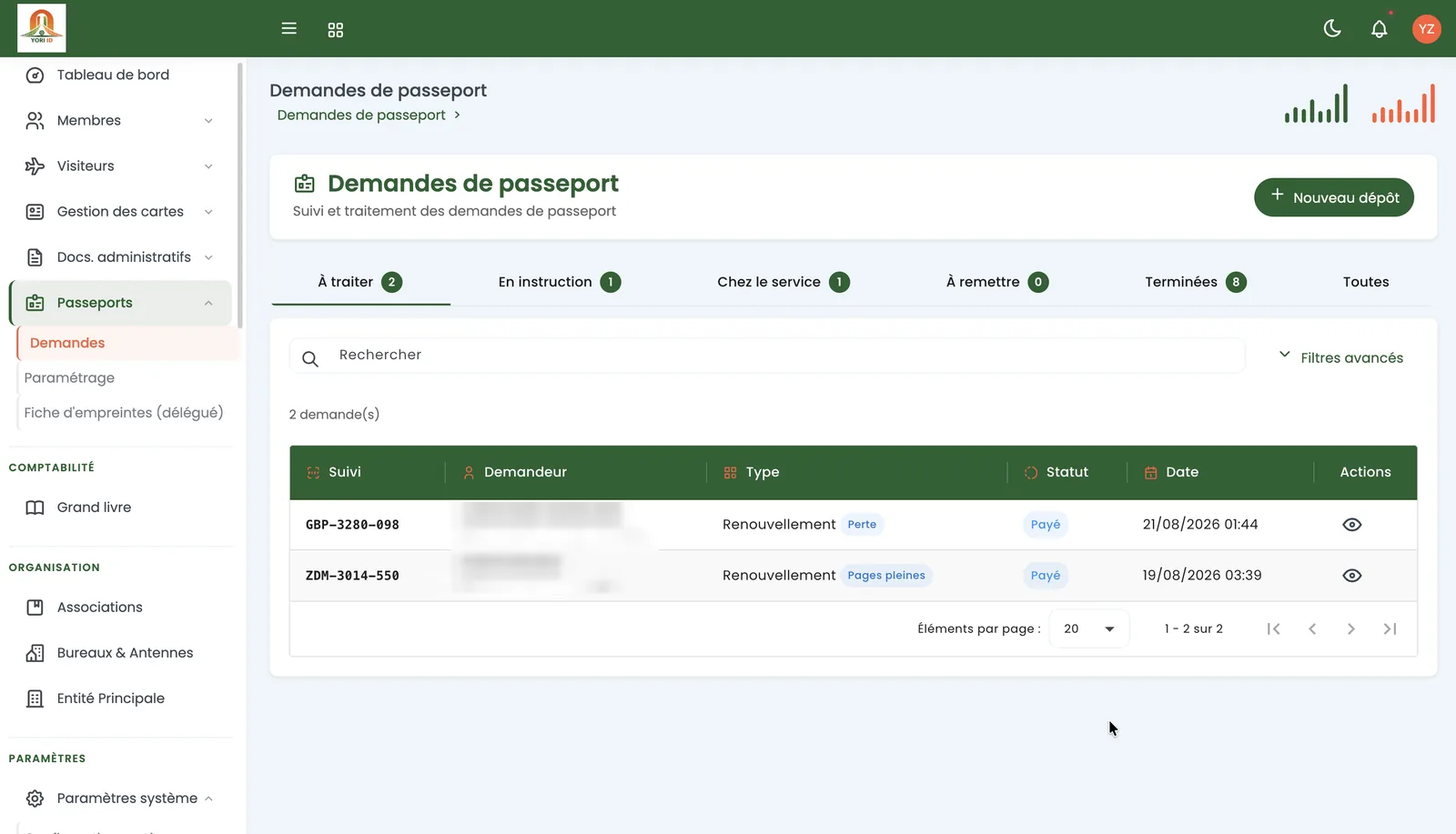
| Stage | State | What happens |
|---|---|---|
| Filing | Awaiting payment → Paid | The case exists, fees are settled, the receipt is issued |
| Processing | Under review | A consular officer checks admissibility, document by document |
| Rework | Corrections requested | Only rejected documents are re-uploaded; the case returns to review automatically once nothing non-compliant remains |
| Admissibility | Case compliant | Invitation to fingerprint capture, sent automatically |
| Fingerprints | Fingerprints received → Case complete | The sheet is attached to the case, then validated; a non-compliant sheet returns the case to the previous state with a mandatory comment |
| Transmission | Transmitted → Received by the service | The case goes to the passport service, which acknowledges receipt |
| Production | Passport issued | The credential is produced and its number recorded |
| Handover | Ready for collection → Handed over | The applicant is notified, collects the credential, the case is closed |
An electronic shuttle with the passport service
The passport is produced neither by the mission nor by a private contractor: it is produced by the passport service of the country of origin. Between the two, common practice is still the diplomatic bag or email — with no acknowledgement, no trace, and no recourse when a case goes missing.
In YORI-ID that service has its own access. It sees the cases transmitted to it by every embassy in the network, downloads each complete case as a single archive — form, documents, receipt — and every download is traced.
It acknowledges receipt, and the applicant is notified of it. It can return a case for correction or reject it, and the embassy is informed. It then records issuance by entering the credential number.
- Completeness check on mandatory fields before transmission: an incomplete case does not leave
- Case archive downloadable by the service, every download logged
- Acknowledgement, return for correction and rejection, each notified to the right party
- A rejection requires a reason; reinstating a rejected case takes a dedicated role and leaves an auditable trace
Corrections without re-entry
A rejected document does not send the applicant back to the start of the form. The "corrections requested" state lists only the documents at fault, with the reason for rejection, and reopens only those for upload.
That is the difference between a case that completes and a case that is abandoned. A forty-field form to re-enter because of one unreadable photocopy is the leading reason people give up on an online procedure.
Fingerprints: at the consulate or with an authorised delegate
Fingerprint capture requires physical presence. For a diaspora spread across a territory the size of a European country, requiring travel to the consulate effectively reserves the passport for those living in the capital.
YORI-ID supports delegation: the mission authorises partner associations, whose delegate submits the applicant's fingerprint sheet. The sheet is filled in by hand, then scanned and attached to the case — the platform does not claim to capture biometrics, it organises the path and checks compliance.
Minors below an age the mission configures are exempt: their case moves straight to the complete state.
Urgent applications, minors, pre-filled form
- Optional priority handling, against a surcharge and a turnaround stated at the moment of choice — not discovered after payment
- Filing for a minor child by their parent, both being enrolled and validated members
- Pre-filled application form as a PDF carrying a signed QR code; the applicant's copy is watermarked
- Nine milestone emails — confirmation, payment, corrections, invitation, rejection, collection, service acknowledgement — each of which the mission can switch off individually
- Enrolment prerequisite: only a validated member can file, which keeps phantom cases out of the pipeline
Frequently asked questions
Does YORI-ID produce the passport itself?
No. The credential is produced by the passport service of the country of origin. YORI-ID covers everything around it and, above all, the shuttle with that service: case transmission, acknowledgement, return for correction, issuance. That is the part where applicants currently lose track.
How does the passport service receive cases?
Through its own access to the platform, where it sees cases transmitted by every embassy in the network and downloads each as a complete archive. Every download is logged, and acknowledgement is notified to the applicant.
Does the platform capture fingerprints?
No. Capture stays manual, at the consulate or with an authorised delegate. The sheet is scanned, attached to the case and validated by an officer; a non-compliant sheet returns the case to the previous stage with a mandatory comment.
Can fees be paid without filing a case?
Yes. That type issues an official receipt verifiable by QR code, and can be attached to an existing case by its tracking number. It applies when fees are called for on a case in progress, or when paying on behalf of a relative.
What becomes of a rejected application?
Rejection requires a reason. Reinstatement remains possible, but takes a dedicated role and leaves an auditable trace: nobody reopens a case unseen.