
Consular solution for a foreign ministry
A ministry does not lack data: every post produces some. It lacks comparable data. Thirty missions counting their nationals by thirty different conventions do not yield a national figure, they yield thirty figures.
The cost of an unconsolidated network
Answering a parliamentary question on how many nationals live in a given country today mobilises several posts, several weeks, and produces an order of magnitude.
Sizing an assistance scheme, deciding whether to open a consulate, negotiating a mobility agreement: each of these decisions assumes a reliable population base that the network, as it stands, cannot produce.
Consolidation comes from the system, not the posts
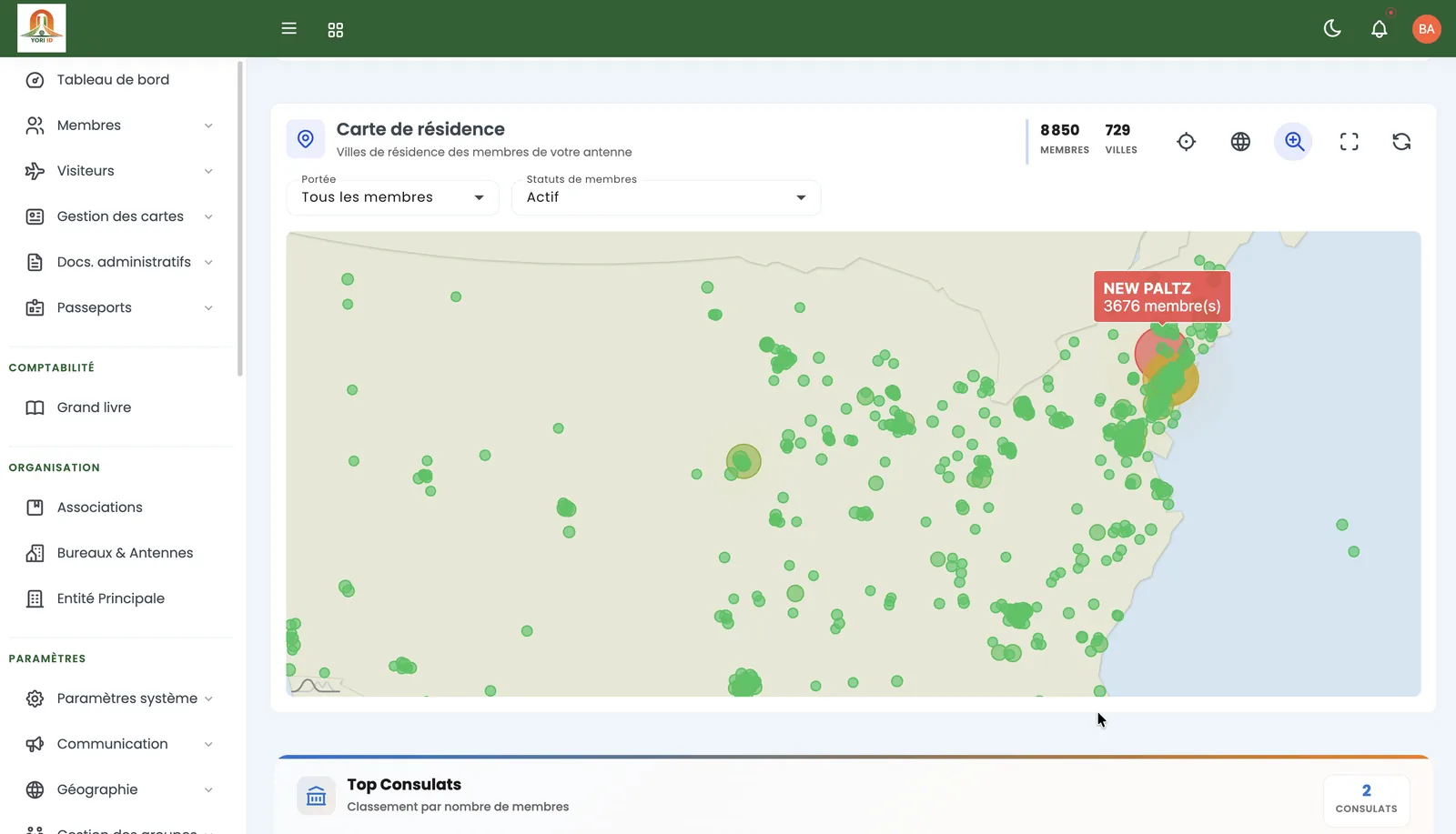
National figures are produced by the platform that runs the operations. There is no reporting campaign to launch, no format to impose, no chasing of short-staffed posts.
The ministry reads in real time the numbers enrolled by status, credentials issued, pending requests and recent activity, across the whole network.
Reading without dispossessing the posts
Ministry access cuts across the network and is read-only. That is deliberate: a post that fears a central service touching its cases keeps a parallel register, and the central system hollows out.
Each mission keeps control of its operations, its branding and its catalogue. The ministry observes, measures and decides.
Measuring whether the programme works
A digitalisation programme is judged on one indicator: the share of procedures that actually moved online. Each embassy's view carries the proportion of credentials issued through the digital channel.
That is what separates a mission that adopted the tool from a mission that installed it — a distinction project dashboards rarely make.
Sovereignty and reversibility
A consular register is a national population file held outside the national territory. The three deployment models — shared, dedicated, on premise — answer different requirements, and data location is a matter of contract.
Reversibility is written into the contract as much as implemented: a mission's data and the network's export to open formats, with no vendor involvement.
A rollout that blocks nobody
Go-live happens post by post, starting from a pilot mission whose feedback corrects the configuration. Each post advances at the pace of its data migration and officer training, without holding up the network.
Frequently asked questions
Can the ministry act on a mission's cases?
No, its access is read-only. That is a choice: preserving the posts' operational sovereignty is the condition for them to actually use the system.
Must the whole network be deployed before there are figures?
No. Consolidation covers the missions already deployed and grows as others join. Missions not yet connected are flagged as such, not counted as zero.
Where is the data hosted?
It depends on the model: shared, dedicated with a contractual location, or on premise operated by the state.
What happens at the end of the contract?
Data exports to open formats with no vendor involvement. We recommend writing reversibility into the contract rather than relying on the software function alone.