
Authenticity checking by scan
A consular credential is only worth something if someone can verify it. As long as checking rests on how the card looks — is the logo crisp, the printing clean — it rests on an officer's judgement against a forger who does nothing else all day.
An app for officers, not another form
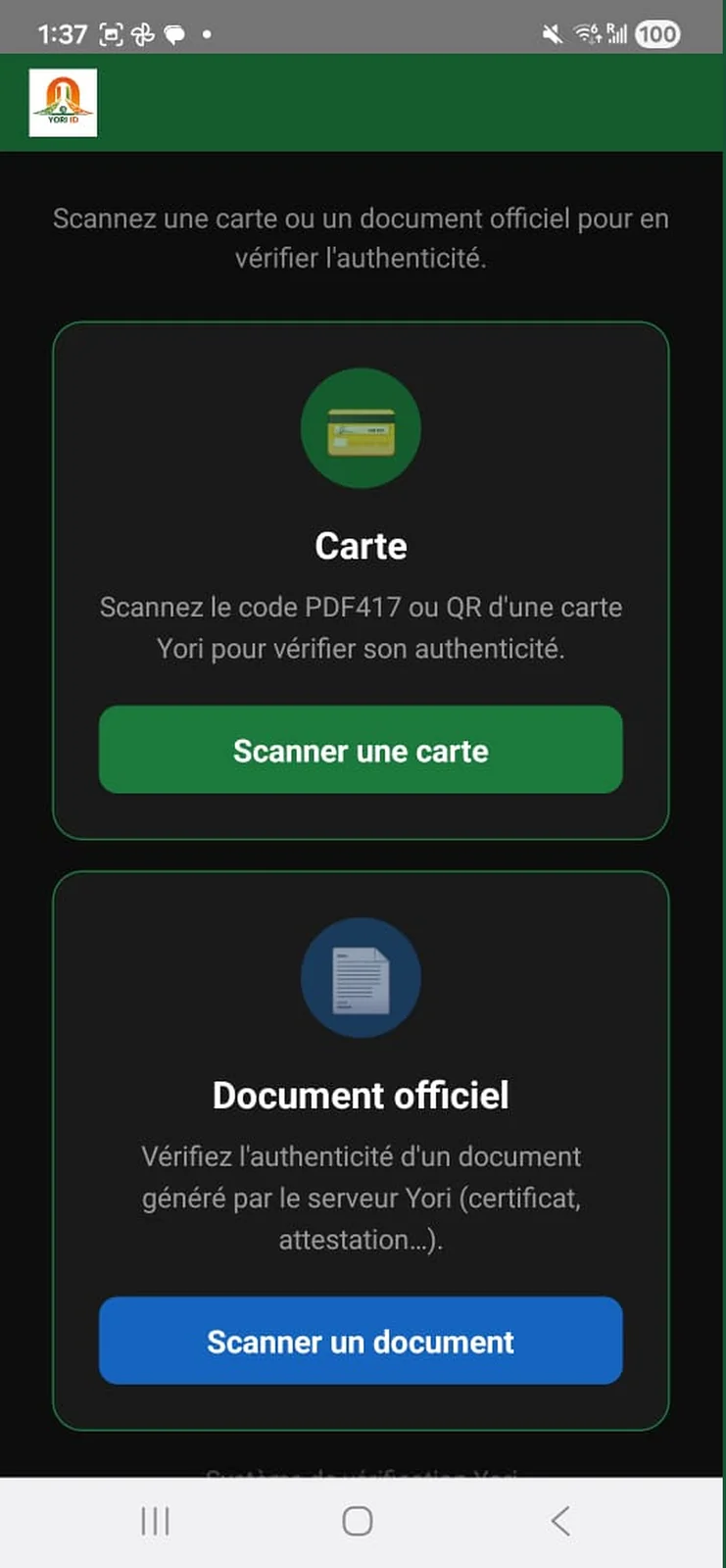
Mission officers and the authorities it authorises have a mobile app. It scans the code on the credential and shows a verdict. There is nothing to type and nothing to interpret.
Today the app verifies consular cards and administrative documents. Every artefact the platform issues — cards, documents, passport application forms, receipts — already carries the same signing mechanism, and the unified checking endpoint is live server-side.
The app is published as Yori Scan and can be downloaded publicly. We give the link because a screenshot asserts, whereas an installable app can be checked: an evaluation panel can try it without asking us.
A forgery never resembles a genuine credential
The code on a credential is cryptographically signed by the platform at issuance. A code fabricated from scratch or altered afterwards is rejected at signature verification, before the record is even consulted.
That is what separates verification from visual inspection: the question is no longer "does this look authentic" but "is this signature ours". A forger cannot produce the latter, however good their printing.
The signature also carries the issuer: one mission's genuine credential does not pass as another's. A valid credential moved from one post to another is detected.
Three questions most systems conflate
"Is this document valid" is not one question but three, and conflating them produces wrong verdicts in both directions: a genuine credential refused, or a suspended one accepted.
- A stolen card that has been suspended is authentic and on record, but invalid — the app says so in plain words rather than returning a misleading binary verdict
| Question | What it checks | Where it alone fails |
|---|---|---|
| Authentic? | The signature is indeed the platform's | A forged or altered credential |
| On record? | The credential appears in the mission's register | A signed code for a record since deleted |
| Valid today? | Not expired, suspended, cancelled or revoked | A stolen card since put on stop |
The check is on the person, not the plastic
Alongside the verdict comes the holder's record as held on file: name, number, status, credential attributes, and the photograph captured at enrolment.
The officer therefore compares the face in front of them with the photograph in the register, not with the one printed on the credential. Physically forging a card becomes pointless: what is being compared is no longer on the card.
A register of checks, not just a checking tool
Every scan is logged — timestamp, result, origin — and can be consulted and exported from the back office.
So the mission knows which credentials are being checked, where, and how many verifications fail. It is the only way to learn that a forgery is circulating before an incident reveals it: a run of negative verdicts on one credential type is a signal, not an anecdote.
What the system does not do
Verification requires the server. That is a deliberate choice: a credential's validity changes over time — a stop, a suspension — and a verdict returned offline would declare valid a credential that no longer is. Better to give no answer than a wrong one.
Nor does the app read third-country identity documents. It verifies the credentials the platform issued, which are precisely the ones whose authenticity it can guarantee.
Frequently asked questions
What does the app verify today?
Consular cards and administrative documents. Every artefact the platform issues — including passport application forms and receipts — already carries the same signed code, and the unified checking endpoint is live server-side.
Is the app publicly available?
Yes, as Yori Scan on Google Play, published by Intercom IT. It is intended for officers and authorised bodies, but its existence can be verified with no formalities — which we prefer to a screenshot.
Can a third party verify a receipt without the app?
Yes. Receipts can be verified from a public page, by number or code, with nothing to install. That is what a bank or an employer receiving a proof of payment needs.
Does verification work offline?
No, and deliberately so. A credential's validity changes — stop, suspension, expiry — and a verdict returned without the server could declare valid a credential that no longer is.
How is a stolen card detected?
It remains authentic and on record, but putting it on stop makes it invalid. The app separates these three questions and shows the invalidity, instead of a binary verdict that would let the credential through.
Does the app read foreign passports?
No. It verifies credentials issued by the platform, whose signature it can guarantee; it is not a reader for third-party identity documents.